What Is the Feast of Tabernacles and How Does Jesus Fulfill It?
Steven Ger
24 September 2026
What Is the Feast of Tabernacles and How Does Jesus Fulfill It?
Sukkot, also known as the Feast of Tabernacles or the Feast of Booths, is one of the most joyful and visually rich celebrations in the Bible. It is also one of only two biblical holidays mentioned as continuing into the future. Understanding this feast helps us understand who Jesus is and what He came to do.
What Is the Feast of Tabernacles?
Sukkot begins on the 15th day of the seventh month on the Hebrew calendar, placing it five days after Yom Kippur, the Day of Atonement. It lasts seven days, with an eighth day added at the end. Because it falls on the first full moon of fall, it is easy to spot on the calendar.
As Leviticus 23 describes it, God commanded His people to live in temporary booths, or sukkot, for seven days. The reason is stated clearly: “So that your generations may know that I made the people of Israel live in booths when I brought them out of the land of Egypt.”
This is a holiday designed to be joyful. After the solemnity of Yom Kippur, Sukkot arrives as a celebration of freedom and dependence on God. It is also the third of the great pilgrimage festivals, when all of Israel was called to gather at the central place of worship.
What Are the Symbols of Sukkot?
Two main symbols define this holiday: the sukkah itself and the four species.
The Sukkah (Temporary Booth)
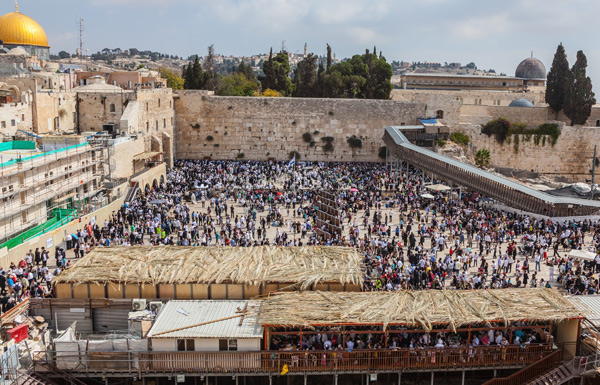
The sukkah is a temporary structure with three walls and a roof made of organic material. The roof must be open enough that the sky can peek through. It is not built for permanence. Nothing is hammered or tacked down. This intentional fragility is the point. It reminds God's people that their security does not come from what they build, but from Him.
The Four Species
God commanded in Leviticus 23 that the people take four agricultural elements and rejoice before Him:
- the fruit of a majestic tree (the etrog, a dense citrus fruit)
- branches of palm trees
- boughs of leafy trees (myrtle)
- willows of the brook
The palm branch, myrtle, and willow are bound together into what is called a lulav. The lulav and etrog are held together and waved in every direction, north, south, east, west, up, and down. This act is a physical reminder that God is not confined to one place. He is everywhere. When we pray, we are not speaking to the floor or to the backs of our eyelids. We are speaking to a God who fills all directions.
Was Sukkot Forgotten for Centuries?
Remarkably, yes. The book of Nehemiah records that after the return from Babylonian exile, the people rediscovered the command to build booths and realized it had not been observed since the time of Joshua. That is roughly eight centuries of neglect. When they finally kept it again, there was great rejoicing. This is a reminder that rediscovering what God has commanded is always worth celebrating.
What Happened at Sukkot in Jesus’ Time?
By the time of Jesus, Sukkot had become one of the most elaborate and joyful celebrations of the year. One of its central rituals was the water ceremony.
The Water Ceremony and Its Meaning
Each day of the feast, the high priest would carry a golden pitcher down to the Pool of Siloam, fill it with water, and process back through the city to the temple courts. The crowd would wave their lulavs and cry out from Psalm 118: “O Lord, do save us. Blessed is the one who comes in the name of the Lord.” In Hebrew, this is “Hoshiana. Baruch haba b’shem Adonai.” These are the same words the crowd shouted when Jesus rode into Jerusalem on Palm Sunday.
The water was then poured out as an offering. This ceremony was rooted in Isaiah 12:3: “Therefore you will joyously draw water from the springs of salvation.” Water was not just water. It was a symbol of the Holy Spirit, of God’s blessing and presence poured out on His people. The ceremony was also a prayer for rain in the coming season, because without rain, there would be no harvest and no food.
What Did Jesus Say at the Feast of Tabernacles?
John 7 records that on the last and greatest day of the feast, Jesus stood up and cried out: “If anyone is thirsty, let Him come to Me and drink. He who believes in Me, as the Scripture said, ‘From his innermost being will flow rivers of living water.’” John then explains that He was speaking about the Holy Spirit.
This was not a casual statement. Jesus interrupted the most significant moment of the most joyful festival of the year to declare that He was the fulfillment of everything the water ceremony pointed to. He was offering not physical water but the Spirit of God, freely, to anyone who was thirsty.
Isaiah 44 makes the connection clear through Hebrew poetic parallelism. The passage reads: “I will pour water on the thirsty land and streams on the dry ground; I will pour My Spirit upon your descendants, My blessing on your offspring.” Water equals the Spirit. Thirsty land equals God’s people. Jesus was claiming to be the one through whom that promise would be fulfilled.
How Does Jesus Fulfill the Feast of Tabernacles?
There are three distinct ways Jesus fulfills this holiday.
1. He tabernacled among us.
John 1:14 says: “The Word became flesh and dwelt among us, and we saw His glory, glory as of the only begotten from the Father, full of grace and truth.” The Greek word translated “dwelt” is the verb form of the word for tabernacle. Jesus, the Son of God, literally tabernacled among His people. His very presence on earth was the fulfillment of what the feast pointed to.
This is confirmed at the Transfiguration, when Peter, overwhelmed by the glory of Jesus shining on the mountain alongside Moses and Elijah, offered to build three sukkot for them. Before he could finish speaking, a bright cloud overshadowed them. God Himself was the tabernacle. No booth needed to be built.
2. He will be worshiped at Sukkot in the Messianic age.
Zechariah 14 describes a future time when all nations will be required to send representatives to Jerusalem each year to worship the King and celebrate the Feast of Booths. Any nation that refuses will receive no rain. Rain here carries the same symbolic weight it does throughout the feast: it represents the blessing and Spirit of God. This is not a minor detail. Sukkot is one of only two biblical holidays explicitly mentioned as continuing into the millennial reign of Christ. Learning it now matters.
3. He is the eternal Tabernacle.
Revelation 7 describes a great multitude from every nation standing before the throne, holding palm branches, just as one would at Sukkot. They cry out: “Salvation to our God who sits on the throne and to the Lamb.” There is no longer a cry of “save us now.” Salvation has come. The text then says that God “will spread His tabernacle over them.”
And at the very end of Revelation, in the eternal state, a loud voice from the throne declares: “Behold, the tabernacle of God is among men, and He will dwell among them, and they shall be His people, and God Himself will be among them.” God Himself becomes our lasting, eternal tabernacle. The feast that began with Israel building temporary shelters in the wilderness ends with God dwelling permanently with His people forever.
What about Giving during Sukkot?
Sukkot was also a time when the Jewish people brought tithes to support the temple and the city of Jerusalem. This is a good moment to reflect on what the New Testament actually teaches about giving. It is not a strict 10% formula. The New Testament calls believers to give generously, sacrificially, in proportion to how God has blessed them, and cheerfully. As Paul writes, God loves a cheerful giver. The right amount is the amount that is genuinely sacrificial for you, given with a glad heart, not out of compulsion or calculation.
Life Application
The Feast of Tabernacles is a physical, hands-on reminder that we are dependent on God for everything. The temporary booth, the open roof, the waving of branches in every direction, all of it points to a God who is present, who provides, and who cannot be contained. Jesus stepped into the middle of this celebration and said, “I am what you are looking for.”
This week, take time to reflect on where you are placing your sense of security. Are you trusting in permanent structures, your own plans, your finances, your routines? Or are you living with the open-roof awareness that God is your true shelter?
Ask yourself:
- In what areas of my life am I building something permanent when God is calling me to trust Him instead?
- Am I thirsty for the Spirit of God, and am I coming to Jesus to drink?
- Do I live with the awareness that God is present in every direction, not just when I close my eyes to pray?
- Am I giving generously, sacrificially, and cheerfully in proportion to how God has blessed me?
The challenge this week is simple. Find one moment each day to pause, look up, and acknowledge that God is your tabernacle. He is your shelter. He is your provision. He is the living water you need. Come to Him and drink.