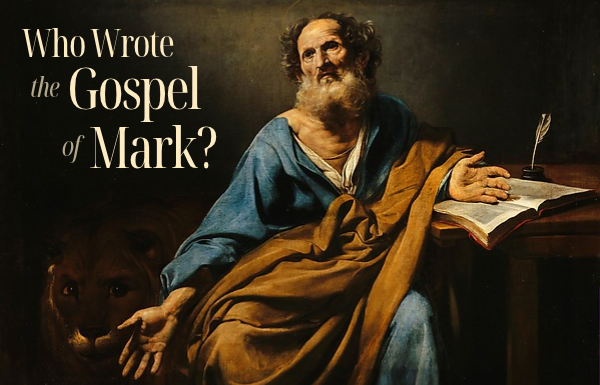
Who Wrote the Gospel of Mark?
Steven Ger
12 October 2026
Who Wrote the Gospel of Mark? An Introduction to the Jewish Journey Through Mark
The Gospel of Mark is one of the most action-packed, fast-moving accounts of the life of Jesus in all of Scripture. Before diving into the text itself, it helps to understand who wrote it, why they wrote it, and who they wrote it for. These answers are more fascinating than you might expect.
Who Actually Wrote the Gospel of Mark?
The book itself never says “I, Mark, wrote this.” Unlike Paul's letters or Peter’s epistles, this is a narrative, not a personal letter. So how do we know Mark wrote it?
What Do the Ancient Manuscripts Say?
Every ancient manuscript we have, going back to the third and fourth centuries, carries the same title: “According to Mark.” There are no competing titles. No manuscript disputes the attribution. That kind of consistency across centuries of ancient documents is significant evidence on its own.
What Did the Early Church Fathers Say?
One of the most compelling pieces of external evidence comes from a church father named Papias, who lived between 60 and 135 AD. He was a student of the Apostle John, which means his testimony carries enormous weight. He recorded what John himself taught about the Gospel of Mark:
“Mark became an interpreter of Peter. As many things as he remembered, he wrote down accurately, though certainly not in order, the things said or done by the Lord. For he neither heard the Lord nor followed Him. But he came later, as he said with reference to Peter, who taught whenever the need arose... For he planned out one goal ahead of time, namely to leave out nothing which he heard of and not to falsify any of the words of Peter.”
This is a remarkable statement. According to John, through Papias, Mark was essentially Peter’s scribe. He recorded Peter’s sermons, stories, and presentations of the gospel faithfully, even if not always in chronological order.
Who Was John Mark?
John Mark appears in the Book of Acts as an assistant to Paul and Barnabas on their first missionary journey. He famously abandoned them midway through the trip, which caused a significant falling out. When Paul and Barnabas prepared for a second journey, Barnabas wanted to bring Mark again, but Paul refused. The disagreement was sharp enough that the two parted ways entirely.
But the story does not end there. By the time Peter writes his first epistle, he refers to Mark with striking affection. In 1 Peter 5, he calls him his son. Mark had clearly been restored and had become one of Peter's closest companions and assistants.
There is also a deeply personal detail tucked inside the Gospel of Mark that no other gospel includes. It describes a young man at the scene of Jesus’ arrest who was wearing only a linen cloth. When soldiers grabbed at him, he fled naked. Most scholars believe this is Mark himself, quietly inserting his own embarrassing cameo into the story. It is exactly the kind of self-effacing detail an honest eyewitness would include.
The Upper Room where Jesus held the Last Supper is also traditionally identified as the home of Mark’s mother. After the resurrection and ascension, the early church gathered there. When Peter was miraculously released from prison in Acts 12, he ran straight to that house, where believers were praying. Mark and Peter had a relationship spanning nearly three decades.
When Was the Gospel of Mark Written?
A reasonable window for the date of composition is approximately 56 to 62 AD. Here is why that range makes sense:
- Mark was traveling with Paul in the late 40s and was not yet closely associated with Peter.
- Peter died around 62 to 63 AD. Some church fathers say Mark wrote before Peter’s death, others say after. Either way, the range holds.
- Luke’s Gospel is dated to around 62 to 63 AD, and Luke depended on Mark. That means Mark had to be written before Luke.
- Second-century church fathers Papias, Clement, and Irenaeus all agree that Mark’s content is based on Peter’s recollections.
Claims that the Gospels were written two or three generations after Jesus are not supported by the historical evidence. Within one generation of Jesus’ life, death, and resurrection, these accounts were being committed to writing. That matters deeply for their reliability.
Who Was the Gospel of Mark Written For?
The Gospel of Mark was most likely written for Roman believers, a predominantly Gentile audience. Several clues point in this direction:
- Every Aramaic expression in the book is translated and explained, indicating the audience would not have understood it naturally.
- Jewish customs are explained rather than assumed, suggesting readers were not deeply familiar with Jewish practice.
- Latin words appear throughout the text, consistent with a Roman audience.
- There are fewer Old Testament quotations and Messianic prophecy references than in Matthew, Luke, or John.
- New Testament epistles (including Colossians 4, 2 Timothy 4:11, Philemon 24, and 1 Peter 5) all place Mark in Rome or nearby during the relevant time period.
What Is the Purpose of the Gospel of Mark?
Mark wrote to commit Peter’s witness to writing so it could be taught and distributed broadly to the Roman churches. He was not simply preserving history for its own sake. He had a specific goal: to present the actions of Jesus in a way that would move readers to faith.
Think of it this way. Mark is not just presenting evidence. He is presenting evidence with a purpose. He wants you to be convinced. He wants you to become a follower of the Messiah.
What Is the Theme of the Gospel of Mark?
Mark presents Jesus as God’s suffering servant. This is not a chronological biography. It is a topical and thematic presentation of the actions of Jesus, arranged to show who He is and to provoke a response of faith.
Notice the emphasis on actions. This is an action gospel. Jesus speaks, but the focus is on what He does. The pace is fast. The stories move quickly. And from the very first verse, you are thrust into the middle of the story.
How Is Mark Different from the Other Gospels?
Each Gospel has its own approach:
- Luke presents events in careful chronological order.
- John organizes everything around the Jewish calendar and holidays.
- Matthew writes with a heavily Jewish audience in mind, drawing deeply from Old Testament prophecy.
- Mark is topical and thematic, organized around what Peter remembered and taught, not necessarily in the order it happened.
There is also something notable about what Mark leaves out. There is no birth narrative. No angelic announcement to Mary. No Joseph’s dreams. No wise men, no shepherds, no flight to Egypt. The Gospel of Mark opens with Jesus already grown, already beginning His ministry. It is an action gospel from the very first word.
Why Do We Need All Four Gospels?
Each Gospel gives a different dimension of who Jesus is. Together, they create a full and rich picture of the Messiah. Matthew, Mark, and Luke share significant overlap and are called the Synoptic Gospels, but each one contains material the others do not. No Gospel is redundant. Each one was written for a specific audience, with a specific purpose, and from a specific perspective.
Mark’s Gospel, rooted in the eyewitness testimony of Peter and faithfully recorded by John Mark, gives us something irreplaceable: a fast-moving, honest, action-driven portrait of Jesus as the suffering servant of God.
Life Application
The Gospel of Mark was written with one clear goal in mind: to move people to faith. Peter did not just tell stories about Jesus to fill time. He told them because he believed they had the power to change lives. Mark did not just write them down for historical record. He wrote them so that readers, then and now, would encounter the living Messiah and respond.
This week, consider how you engage with the Gospels. Are you reading them as ancient literature or as a living invitation to know Jesus more deeply?
Ask yourself:
- When I read about Jesus, am I allowing what I read to actually challenge and shape how I live?
- Is my faith based on a real, historically grounded account of who Jesus is, or is it vague and untethered from the actual story of His life?
- What would it look like for me to approach the Gospels this week not just as a reader, but as someone being invited to respond?
The challenge this week is simple but significant. Pick up the Gospel of Mark and read the first chapter. Read it not as an academic exercise, but as someone who wants to encounter Jesus as God’s suffering servant. Let the action of the text pull you in, and ask God to use it to deepen your faith and your understanding of who He is.
Image Attribution Requirement:
Header image: "Saint Mark" (c. 1624–1626) by Valentin de Boulogne. Musée National des Châteaux de Versailles et de Trianon. Public Domain.