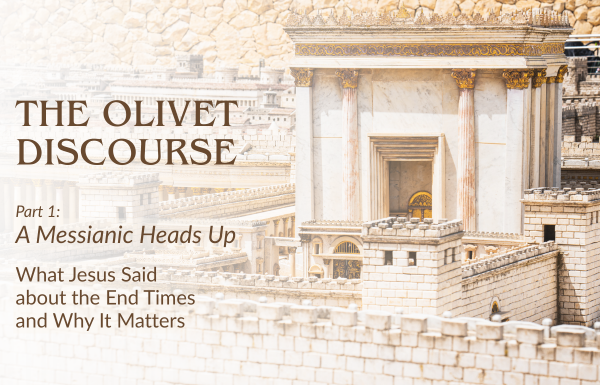
A Messianic Heads Up: What Jesus Said About the End Times and Why It Matters
Steven Ger
23 November 2026
A Messianic Heads Up: What Jesus Said About the End Times and Why It Matters
Many churches avoid the topic of end times prophecy, worried it will divide congregations or make Christianity seem strange to outsiders. But if it was important enough for Jesus to teach, it should be important enough for us to understand. What follows is a look at one of the most significant teachings Jesus ever gave, delivered on the Mount of Olives in the final week of His life.
Why Do So Many Churches Avoid Teaching About End Times?
The study of last things, technically called eschatology, has quietly disappeared from many church pulpits. The common reasons given are that it is too divisive, too confusing, or that it makes Christians look a little extreme to outsiders.
But here is the honest pushback: the gospel of Jesus Christ is already considered foolishness to the world. Believing in unfulfilled prophecy is not what makes Christianity seem radical. If Jesus took the time to teach it, dismissing it is a serious misjudgment.
Setting the Scene: The Temple and a Stunning Prediction
As Jesus and His disciples were leaving the Temple in Jerusalem, one of them marveled at the architecture. And it truly was breathtaking. Ancient sources describe the Temple as covered in gold that reflected the rising sun so brilliantly that people had to look away. The white marble shimmered like a snow-covered mountain from a distance. The Talmud even says that anyone who had not seen Herod's Temple had never seen a truly beautiful building.
So when a disciple said, "Look at these wonderful stones and buildings," it was not the reaction of a tourist. It was someone who had seen this place his entire life, still moved by its beauty.
Jesus responded with something that must have stopped them cold. He said, "Do you see these great buildings? Not one stone will be left upon another which will not be torn down." Every single stone would fall. And history confirms it. In 70 AD, the Romans destroyed the Temple so thoroughly that the massive limestone blocks, heated by fire, expanded and exploded off the walls. You can still see the pile of fallen stones at the base of the western wall in Jerusalem today.
The Question That Started It All
After crossing the Kidron Valley and sitting down on the Mount of Olives, four of Jesus' closest disciples, Peter, James, John, and Andrew, pulled Him aside privately and asked two very direct questions: When will these things happen, and what will be the sign that they are about to be fulfilled?
These are not abstract theological questions. They are the questions of people who just heard their teacher say something world-shaking and wanted to understand it.
What Did Jesus Say About the Destruction of Jerusalem?
Mark's account is a summary, not a full transcript. For a more complete picture, Luke fills in an important detail. Jesus said that when Jerusalem is surrounded by armies, those in Judea should flee to the mountains immediately. He described it as "days of vengeance, so that all things which are written will be fulfilled."
"But when you see Jerusalem surrounded by armies, then recognize that her desolation is near. Then those who are in Judea must flee to the mountains, and those who are in the midst of the city must leave, and those who are in the country must not enter the city; because these are days of vengeance, so that all things which are written will be fulfilled." - Luke 21:20-22
This was not God acting out of hatred toward the Jewish people. It was the consequence of leadership that had rejected and actively worked against the Messiah. Scripture consistently holds nations accountable for the decisions of their leaders. The wrath Jesus described was a fulfillment of what had already been written in the Hebrew scriptures, including Psalm 2, which warns that those who reject God's Son will face His anger.
"Do homage to the Son, that He not become angry, and you perish in the way, for His wrath may soon be kindled. How blessed are all who take refuge in Him!" - Psalm 2:12
What Are the Signs of the End of the Age?
Jesus then shifted to answer the broader question about the end of the age. He gave several clear markers to watch for:
- False messiahs will appear. Jesus warned that many would come claiming to be Him, and that they would mislead many people. History has proven this true. From Bar Kochba in the second century, whom Rabbi Akiva declared to be the Messiah, to more recent figures like David Koresh and Sun Myung Moon, false messianic claims have appeared throughout history and continue today.
- There will be wars and rumors of wars. "When you hear of wars and rumors of wars, do not be frightened; those things must take place; but that is not yet the end." - Mark 13:7
The phrase "nation against nation, kingdom against kingdom" is a Hebrew expression for comprehensive, large-scale warfare. Jesus was not describing regional skirmishes. He was pointing toward something on the scale of world war. And He said clearly: do not be frightened. These things must happen, but they are not the end.
Earthquakes and famines will increase. Jesus also pointed to earthquakes in unexpected places and widespread famines as signs. These are not new phenomena, but their increasing frequency and severity in unusual locations would be noteworthy. He called all of these things "the beginning of birth pangs." Anyone who has witnessed childbirth understands that the first contraction is not the end of the process. It is only the beginning of something much larger.
What Is the Point of All This Hardship?
Here is the verse that is easy to miss when reading through a list of disasters and tribulations. Jesus said this:
"The gospel must first be preached to all the nations." - Mark 13:10
That is not a footnote. That is the point.
Every hardship Jesus described, every arrest, every war, every earthquake, every famine, is not just something believers must survive. It is the very platform through which the gospel travels. Trouble does not silence the message. It moves it.
Believers in every generation, and especially those alive in the final generation, are not simply enduring difficulty. They are the mission. The question Jesus is really asking is not "How will you survive this?" but rather "What does this hardship make possible?"
What Does This Mean for Us Right Now?
We may not be living in the final days of the tribulation. But the principle Jesus laid out applies to every believer in every era. When trouble finds you, the gospel does not stop. It travels.
Challenges do not shut down the mission. They create new opportunities for the message to reach people who might never have heard it otherwise. The disaster is never the end of the story for a believer. It is often the beginning of someone else's story of faith.
Life Application
This week, instead of asking "How do I get through this?" when you face a difficulty, try asking a different question: "What does this hardship make possible?" Look for one person in your life who is going through something hard and bring the hope of the gospel into that conversation. You may be the reason they hear it for the very first time.
Ask yourself these questions as you go into the week:
- When difficulty comes into my life, is my first instinct to retreat or to look for how God might use it?
- Am I familiar enough with what Jesus taught about the future to recognize it when I see it, and to speak about it with confidence?
- Is there someone in my life right now who is in the middle of a hard season, and have I brought the gospel into that relationship?
- Do I treat eschatology as irrelevant to my daily faith, or do I take seriously what Jesus Himself took the time to teach?
The Messiah gave His closest friends a heads up about what was coming, not to frighten them, but to prepare them. He is doing the same for us. The question is whether we are paying attention and whether we are ready to move when the moment comes.